Person Record
Images
Metadata
Name |
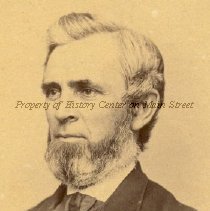
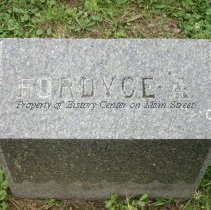
Allen, Fordyce Almon |
Othernames |
Prof. Allen |
Genealogy ID |
82537 |
Born |
10 JUL 1820 |
Birthplace |
Cummington, Hampshire MA |
Deceased |
14 FEB 1880 |
Deceased where |
Mansfield, Tioga PA |
Cemetery |
Prospect Cemetery |
Education |
Mansfield Coudersport Alexandria NY |
Occupation |
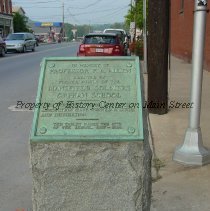
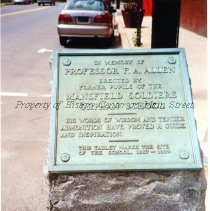
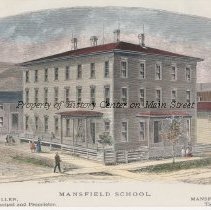
Educator Principal MSNS Principal Soldiers Orphans School |
Father |
Almon Allen |
Mother |
Polly Bates |
Spouse |
Sarah Colwell, Jane Martin |
Children |
Clarence E. Allen Fred M. Allen George K. Allen W. Allen (died Young) Stella R. Allen |
Reference |
Obit |
Notes |
The Late Prof. F.A. Allen A Sketch of his Life & Estimate of his Character Mansfield, February 14, 1880 - Our Professor Allen is done with the troubles of this world, and gone to his everlasting reward. He died last Wednesday evening, February 11, 1880 at his home in this place, of typhoid pneumonia. These are words that will ring like a funeral knell in many lives for years to come. Yes, the grave has closed over our Professor Allen, and the whole town is in mourning. A great calamity has befallen us, for the Lord has slain our Sampson. The main prop is gone, and on what, now, shall the superstructure rest? Oh, we shall not see his like again, and bitter, bitter is the tear that falls upon his grave. Fordyce Almon Allen was born at Cummington, in Massachusetts, on the 10th of July, 1820. When he was two years old his father removed to this place, bringing little Fordyce all the way in a wagon. They went to live in a house built by Jacob Allen, Senior -- dear to the writer of this as the place where he was born. They afterward lived at other places in the vicinity of Mansfield, and in the year 1824 his father erected a woolen factory near the northwest corner of what is now the Smythe Park, which was afterward burned. He was at one time a Captain of militia, and it may be further said of him that he was the father of seven children, of whom Fordyce was the oldest. The grandfather, Jacob Allen, who was a Lieutenant in the war of the Revolution, had preceded the father to Mansfield, first coming as a peddler of woolen goods, axes, etc. He died here December 11, 1836, aged 73 years; and here, 35 years afterward, the father, Almon Allen, died, also aged 73 years. Not long ago, during the present month, the writer saw on a monument of Scotch granite, in our cemetery, the inscriptions "Jacob Allen, aged 73," and "Almon Allen, aged 73," and he thought the subject of this sketch was bidding fair to outlive these ancestors. But, alas, to night he is lying by their side, having perished in the noon of his usefulness; and it remains for us to inscribe, "Fordyce Allen, aged 59." From Mansfield Fordyce, with his father, went to Ohio, and from there they returned to Massachusetts, whence, after remaining for a time, they went to Chautauqua county, NY. Young Fordyce seemed then, at 19 years of age, to have launched out for himself, beginning in the world as a clerk for a man by the name of Clark, in Coudersport, Pa., in 1839; though we believe that prior to this he had served in the same capacity for a short time at Hudson, NY. We soon hear of him, however, as a pupil at school in Coudersport, and then as a teacher; and then -- sometimes teacher and sometimes pupil -- he remained until the year 1844, when he attended a school at Alexandria, NY, for one year, which he often spoke of as his "high school." Returning to Coudersport at the age of 25, he married Sarah Colwell, by whom he had one child. Upon getting married he went to Jamestown, NY, where he taught in the public school for three years, or until 1848, when his wife died, which event occurred on the day of the third anniversary of their marriage. Leaving Jamestown, he became Principal of the High School at Fredonia, NY, where he remained about two years and a half, when his health obliged him to resign. Regaining his health, he accepted the principal ship of the Academy at Smethport, Pa., and in December, 1852, was married to Jane Martin, a most amiable and intelligent lady, who survives him, and to whom Mr. Allen has been indebted more than most of us are aware for the large measure of his success in life. Her principal common sense has ever been his firm sheet anchor. By her he has had four children, all of whom are living, except a little boy of four years, who is buried at West Chester. In 1853 he became editor of the McKean Citizen, and in 1854 he was elected County Superintendent of McKean county, which positions he occupied up to the spring of 1857, when he established a Normal School at West Chester, Chester county, Pa., of which he was Principal for a period of six years. During his stay in West Chester he wrote and published a text book on geography. At the time of the invasion of Pennsylvania by Robert E. Lee he marched at the head of his school and a body of citizens to resist the invasion. In July, 1864, nearly 16 years ago, he came to Mansfield as Principal of the State Normal School, which position he held uninterruptedly for five years, when he resigned. In the fall of 1867 he started the Soldiers’ Orphan School, which he managed with peculiar success up to the time of his death. In the fall of 1877 he again became Principal of the State Normal School for a term of five years, and was serving his third year when he died. I should have said that in the fall of 1854 he began his Institutes, which have ever since been a prominent feature of his work. He was almost constantly engaged in this direction, and his labors were not confined to this State. While at West Chester he spent a winter on Institutes in Wisconsin, and in the autumns of 1869 and ‘70 he held Institutes in Maine, [16 weeks each year -- one week for each county in the State.] The spring of 1871 was given to Vermont, New Orleans and Mississippi, and a few weeks in 1876 were devoted to Institutes in Virginia. Toward the close of the summer of 1879 he made his memorable trip to California, and on his return held Institutes in Kansas. So successful was he in this work, and in all matters pertaining to education, that he had long ago become one of the most prominent educational men in the State and Nation. Thus much of his life; -- a word as to his death: He died, as he had lived, with unshaken confidence in God. A little while before his decease he requested his friends to sing Charles Wesley’s masterpiece, "Jesus, lover of my soul" -- the finest heart hymn in the English tongue. He joined in this lay of holy love, --- "Jesus, lover of my soul. Let me to Thy bosom fly While the billows near me roll, While the tempest still is high! Hide me, O my Saviour, hide. Till the storm of life is past; Safe into the haven guide; Of, receive my soul at last!" Blesses death song! Glorious words of cheer! Thousands of God’s redeemed ones have sung it, and will be singing it till the end of time. How could one better choose his manner of departure than to die singing, -- "Other refuge have I none; Hangs my helpless soul on Thee; Leave, ah, leave me not alone, Still support and comfort me. All my trust on Thee is stayed, All my help from Thee I bring; Cover my defenseless head With the shadow of Thy wing." Shortly after breathing this prayer he died, at 8o’clock on Wednesday evening, after a short illness of only one week, regretted by all who knew him. The funeral was attended on Friday afternoon, February 13th, at two o’clock. And such a funeral! The like has never been seen in Mansfield, and probably will not be again soon. Business was entirely suspended throughout the day; and although in the midst of a continuous, drizzling rain, which deterred hundreds in the country from coming, the whole town turned out, so that the large church could hold but part of the vast throng. The impressive services were held in the Episcopal church, of which the deceased was a valued member. The voice of the preacher and the tears of those with whom he had been accustomed to worship told too plainly of our irreparable loss. During the services his favorite hymns, "Asleep in Jesus" and "Jesus, lover of my soul," were sung. In the vestibule an opportunity was given for those who wished to view the remains. The coffin was black walnut, plain but rich, and covered with a profusion of callas, geraniums, etc. The inscription read, "Fordyce Allen, aged 59." The pall bearers were Messrs. King, Sherwood, Spencer, Van Ness, Sperry and Blackwell. Despite the inclemency of the weather, the procession of people on foot was the largest ever seen here, reaching all the way from the village to the cemetery on the hill, nearly half a mile away. It included the students of the State Normal School, besides nearly 400 pupils from the Soldiers’ Orphan School and the children of the public school. Such an outpouring in the midst of a storm plainly attested the hold of the deceased upon the hearts and affections of the people. Many were present from a distance, and among the number Prof. Ford of Elmira Female College, who was the bearer of the following communication: "The President and Faculty of Elmira Female College to the Family and Friends of Prof. F.A. Allen: Having learned, with great sorrow, the fatal sickness and too early death of Prof. Allen, allow us to express our deep sense of his great loss. He was a friend and acquaintance of ours some years, and was our teacher of ____ two years. How bright and clear were his lectures -- how gentle and genial his _______! At once all learned to love him. In his occasional visits to the college he always seemed to bring with him the ripe wisdom of a scholar made rich with a large and useful experience of the world. To us he ever seemed unconscious of his own rare and magnetic gifts. He observed _____ but kindly. His faith in the fellowmen was _________ and lasting as his efforts to do them good. How many youths will bless him as a fountain of influence and stimulus to a higher life. Pennsylvania has lost one of its foremost educators; we have lost a loved and valued friend, our youth a revered instructor, the Church a devout worshiper, and his kindred the dear love, light and strength of their home. May the Fatherhood of our gracious God meet us all in this great sorrow. If his earthly form is seen no more till "the restitution of all things," be it ours to cherish "the eternal form of his mind," and to keep alive in our hearts that grateful memory of his useful life. It is impossible upon so short notice to give a proper estimate of the life and character of Prof. Allen. And indeed it is not necessary that we should enlarge upon his zeal in the sense of education, religion, agriculture and temperance, [for all which he had our abiding love,] nor upon the improvements which have added so much to the growth and prosperity of out town; -- these are things which are known and rend of all even. Self-made, and springing from the rank and file, he belonged to the people, and they will cherish his memory long after our eulogies are forgotten. He was not a bookish man, nor was he college bred; but he had what is for better -- a wide general information. Man, rather than books, and God, rather than man, had been his study, which conspired to make his life intensely individual and one which constantly increased in good works. He was in easy circumstances, but he valued money only as a means to an end; and among the poor is many a man whose swimming eyes tell that he has lost a friend, for his liberality to the suffering poor was proverbial, and he gave employment to a large number of this class. [Here is an example worthy of imitation by those men of wealth who, miser like, are hoarding up their money. Use it, not only for your own good, but for the good of the community in which you reside, and your name, like his, shall live.] He stood on a basis brand as the world; no one Church or party could hole him; no one community could claim him. As to personal appearance, he was tall and well developed in his physical frame, with a fair coronet of hair like rifted snow, pleasant eyes under arching eyebrows, and a handsome face; possession easy and polished manners and a very joyous temperament, together with a wealth of sympathy. Perhaps the most notable traits in his character were his untiring energy, his cheerful self-sacrifice and his "rock firm God trust." It may safely be said that he was the most active man in the county, perhaps in the State, and he exemplified in his daily life the motto which he urged on the minds of his pupils -- "It is better to wear out than to rust our." He was eminently unselfish; he lived for others, and the world is the better for his words and deeds. For it is not so much what a man is as what a men does that preserves his memory and leaves behind him a never-dying influence for good. Mary poured her box of precious ointment out upon the head of the beloved Master until the odor of the costly gift filled the room, and we read that is shall be told for a memorial of her. So his deeds shall be his everlasting memorial, and "the good he has done" shall be his enduring monument. His faith in his fellow man was only surpassed by his unbounded faith in God. He knew in whom he had trusted; and his beaming face was a silent psalm assuring the beholder, "Happy is the man that hath the God of Jacob for his help." In the triumph of this faith he fell asleep -- put off this earthly tabernacle -- broke loose from the bonds of the flesh, as one loosens a vessel from detaining shores to be wafted away upon peaceful waters toward a safe and pleasant haven. And tonight he is in the Promised Land, beyond the Jordan of Death, where the pines wave green on the eternal mountains. The peerless man and brother, who had found his earthly tabernacle for too narrow to hold in thrall the invisible fires of immortality, has gone to "that undiscovered country from whose bourne no traveler returns," while the whole town is filled with the fragrance of his life, as that room where Jesus sat at meat was filled with the odor of the alabaster box. As when the son has dropped behind the western hills a mellower, more glorious light remains, so when a good man’s life has exhaled to Heaven, and his sun has gone down in life’s west, the beauty and glory of its beneficence abide." -- spoken by A.S. Resolutions of Respect The following preamble and resolutions were adopted by the Board of Trustees of the State Normal School at Mansfield last week: Whereas, It has pleased an all-wise Providence to remove from among us our esteemed fellow-citizen, Prof. F.W. Allen, as Principal of the State Normal School of the 5th District, we, the Board of Trustees of the aforesaid institution, hereby offer the following resolutions, in token of our appreciation of his invaluable services, not only to the sense of education, but in behalf of the best interests of our entire community. Resolved, That we recognize in this _________ dispensation the loss of one who has been chiefly instrumental in the establishment of our School as well as in raising it to the high elevation it occupies among similar institutions of our State, and whose loss we deeply mourn as personal friends. Resolved, That in _____ of the fact that the cause of education has lost one of its ablest promoters, abroad as well as at home, we extend our sympathy, not only to the pupils of the State Normal and the Soldiers’ Orphan Schools, so lately under his immediate charge, but also to those in other communities to whom his aid and comments have been of great value. Resolved, That we regard with admiration and reverence the spirit of self-sacrifice which induced him to spare neither influence, time, of means, to secure to our community the blessings of temperance, and which rendered him untiring in his zeal for the moral and social advancement of even the humblest of our citizens. Resolved, That we tender our most heartfelt sympathy to the bereaved family of the deceased, and prayerfully commend them to the tender mercy of Him who, in the ________ of his wisdom, has suffered them to be thus afflicted. Resolved, They a copy of these resolutions be furnished the county papers for publication. By order of the Board - P.V. VanNess, President, pro tem.; Fred G. Elliott, Secretary |
Publications |
Textbook on geography |
Imagefile |
People\Allen_Fordyce.jpg |
Related Records
-
-

-
-
-
-
-
-
-
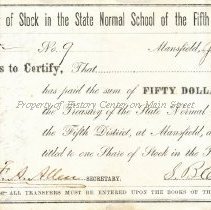
State Normal School of the Fifth District, Stock Certificate. - Certificate, Stock
1868
Record Type: Archive